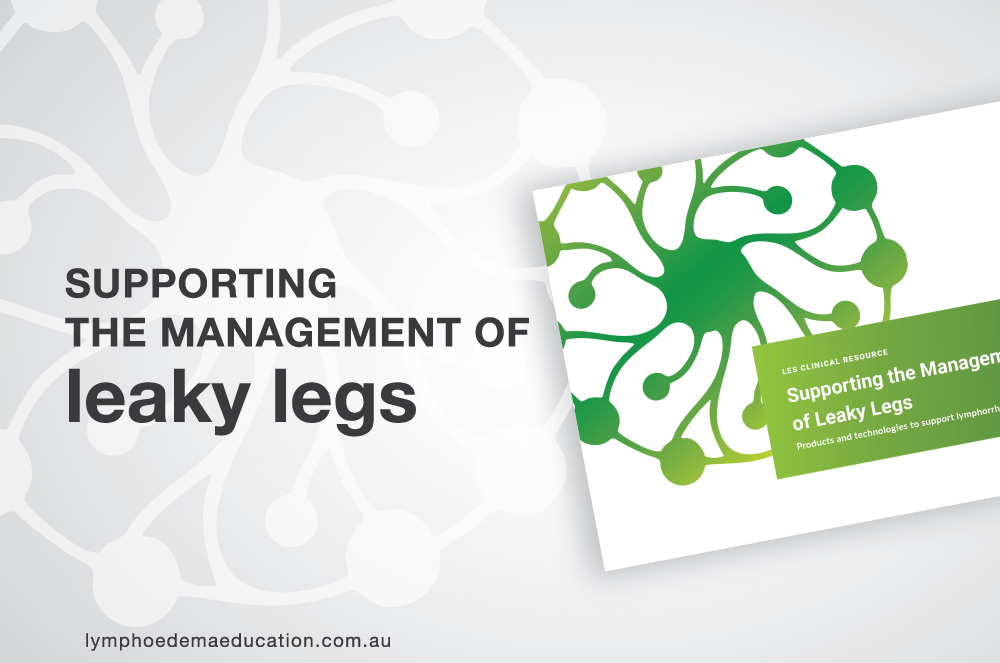
Supporting the Management of Leaky Leg
A practical product guide for lymphorrhoea management
Lymphorrhoea can compromise skin integrity, increase infection risk, affect mobility and quality of life, and create significant challenges for patients, carers and clinicians.
The LES Clinical Resource – Supporting the Management of Leaky Legs Guide brings together examples of products and technologies that may support care from active leakage through to long-term oedema control. It is designed to help clinicians understand where different options may fit within the management pathway, while recognising that product selection must always be guided by clinical assessment and individual patient needs.
What is included in the guide
The guide covers five key areas:
- assessment and monitoring
- skin protection
- dressings and leakage management
- oedema reduction
- ongoing oedema management
It also includes a visual pathway showing how care progresses from increasing oedema and active lymphorrhoea to reduced leakage, improved skin integrity and long-term management.
The guide highlights the role of:
- assessment and monitoring technologies
- absorbent dressings
- skin-barrier products
- compression bandaging
- adjustable compression wraps
- compression garments
- sequential intermittent pneumatic compression
Use alongside the clinical guide
This resource is a companion to the 2025 article, Supporting the Management of Leaky Legs: A Clinical Guide, which provides detailed information about recognising, assessing and managing lymphorrhoea.
The article should be used for treatment principles, while this companion LES Clinical Resource supports product exploration across the different stages of care.
When specialist support may be needed
Lymphorrhoea may be associated with complex oedema, compromised skin, wounds, recurrent cellulitis and significant medical conditions. Management should be undertaken by health professionals with appropriate lymphoedema and compression training.
Referral to a lymphoedema-trained clinician should be considered when:
- the cause or severity of the oedema is unclear
- vascular or medical suitability for compression requires further assessment
- leakage is persistent or worsening
- compression is difficult to select, apply or tolerate
- wounds, recurrent cellulitis, significant skin changes or complex limb shape are present
- a coordinated long-term management plan is required
Clinicians without appropriate training should work within their scope of practice and seek specialist support.
Related LES resources
Additional LES articles on Lymphorrhoea:
- New Position Papers: Updated Guidance for Practice October 2025 including BLS 2025. Lymphoedema Clinical Definitions and Assessment Guide (5S) – https://lymphoedemaeducation.com.au/2025/11/october-2025-position-papers/
- Lymphorrhea – let’s turn off the tap – https://lymphoedemaeducation.com.au/2019/08/lymphorrhea-lets-turn-off-the-tap/
- The Key to Managing Lymphorrhea – https://lymphoedemaeducation.com.au/2016/12/the-key-to-managing-lymphorrhea/
Develop your lymphoedema management skills
LES Level 1 training provides practical, evidence-based education in lymphoedema assessment and management, with a focus on current best practice and hands-on learning.
Training includes:
- online self-paced learning
- face-to-face workshops
- clinical reasoning and practical application
- ongoing mentoring
It is designed to help clinicians build the knowledge and confidence required to manage chronic oedema in the lower limb and recognise when referral is needed.
Important information
This LES Clinical Resource does not replace comprehensive clinical assessment or professional judgement. Compression and dressing selection should be undertaken by appropriately trained health professionals working within their scope of practice. Product indications, availability and instructions for use should be confirmed with the relevant supplier.
Find an ALA Accredited Lymphoedema Practitioner
If lymphorrhoea assessment or management falls outside your scope of practice, consider referral to an ALA Accredited Lymphoedema Practitioner.
The Australasian Lymphology Association’s National Lymphoedema Practitioners Register (NLPR) can be used to find accredited practitioners across Australia and New Zealand, including practitioners qualified to manage lower-limb lymphoedema.
Acknowledging our Industry Partners
LES acknowledges and thanks Essity, Haddenham Healthcare, Hartmann, Huntleigh, ImpediMed / Regional Health Care Group, Lohmann & Rauscher, medi Australia, Medi-Rent, OPC Health and Solventum for supporting the development of this resource and ongoing clinical learning. Inclusion does not imply endorsement, and clinicians are encouraged to apply their own professional judgement in all aspects of patient care.