
Neuroscience and Engagement Strategies for Positive Outcomes
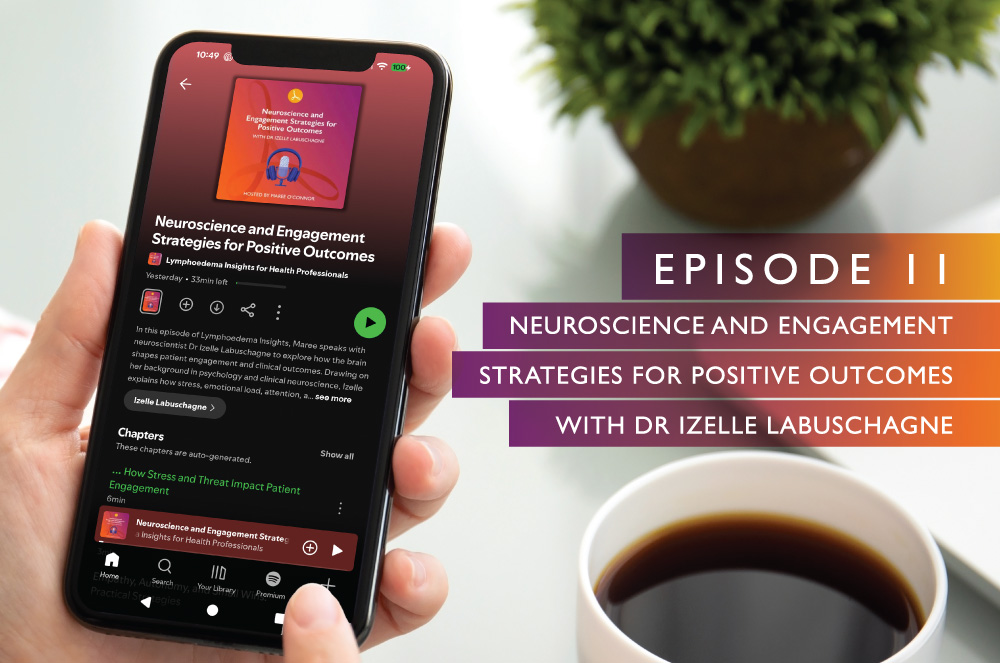
In this episode of Lymphoedema Insights, Maree speaks with neuroscientist Dr Izelle Labuschagne to explore how the brain shapes patient engagement and clinical outcomes. Drawing on her background in psychology and clinical neuroscience, Izelle explains how stress, emotional load, attention, and mental health can influence how patients process information, make decisions, and respond to treatment.
Together, they unpack why engagement is about far more than motivation or compliance. The conversation offers practical insights to help clinicians recognise when neurological and emotional factors may be affecting a patient’s ability to absorb information or follow through with care.
If you’ve ever wondered why some patients struggle to engage despite your best efforts, this episode provides a fascinating neuroscience perspective and practical strategies to support more meaningful and effective clinical interactions.

About our guest speaker: Dr Izelle Labuschagne
Neuroscientist | Research Mentor | Founder, Complete Thesis Support
Dr Izelle Labuschagne completed her PhD in clinical neuroscience at Monash University in 2011 and holds accredited training in psychology from Monash University and Swinburne University of Technology. Her work is grounded in neuroscience, with a particular focus on social cognition and emotion, and how mental health, stress, and ageing influence brain–behaviour relationships. Through Complete Thesis Support, she now works closely with PhD candidates, research students, and early-career researchers, supporting them to navigate the demands of research with clarity, confidence, and sustainability.
Izelle has extensive experience leading human neuroscience and neuropsychopharmacology research, including randomised double-blind placebo-controlled clinical trials involving antidepressants, serotonergic agents, and neuropeptides such as oxytocin. She has worked across academic and industry-sponsored research, with strong expertise in ethics, regulatory processes, and Good Clinical Practice. Today, she integrates this scientific rigour into her mentoring and entrepreneurial work, supporting researchers in navigating complex systems, producing high-quality research, and building sustainable academic or industry careers.
Sponsor
This episode is proudly sponsored by Medi Australia, a global leader in compression therapy and a trusted partner to lymphoedema clinicians
Medi understands that effective lymphoedema care relies on evidence-based compression, patient comfort, and long-term adherence. Their German-engineered flat-knit and circular-knit garments provide effective compression, durability, and wearability, supporting outcomes across early intervention through to chronic, complex presentations.
Medi backs clinicians with education, product support, and responsive customer service, helping improve patient solutions. Through clinical rigour and innovation, Medi continues to improve quality of life for people living with lymphoedema.
For more information, go to mediaustralia.com.au
🎧 Listen to Episode 11
Neuroscience and Engagement Strategies for Positive Outcomes
The following ideas reflect themes discussed in the episode and may serve as helpful reminders when supporting patient engagement in lymphoedema care. Many clinicians will already be using aspects of these approaches in their daily practice.
Empathy and Validation
Patients often engage more readily when they feel understood and heard. Empathy and genuine connection can help reduce stress and build trust.
Considerations for Practice:
- Taking time at the start of consultations for empathetic listening and validation.
- Using eye contact and active listening to signal genuine interest.
- Acknowledging the emotions and challenges patients may be experiencing.
Simplifying Information
Focusing on the most important steps may help prevent patients from feeling overwhelmed by too much information at once.
Considerations for Practice:
- Breaking information into smaller, manageable pieces.
- Highlighting key priorities while acknowledging that care is often a work in progress.
- Reassuring patients that understanding and confidence can develop over time.
Supporting Patient Autonomy
When patients feel they have a role in decision-making, it may strengthen their sense of control and engagement.
Considerations for Practice:
- Offering options where appropriate (for example, different ways to incorporate compression into daily routines).
- Inviting patients into conversations about what feels realistic for them.
- Exploring shared decision-making to support ownership of care.
Normalising Emotional Responses
Emotional responses such as stress or overwhelm are common when adjusting to a chronic condition or new diagnosis.
Considerations for Practice:
- Acknowledging that these responses are understandable and often expected.
- Using language that emphasises collaboration and gradual progress (for example, “We’ll work through this together”).
Encouraging Small, Achievable Actions
Small early successes may help build confidence and motivation, engaging the brain’s reward pathways.
Considerations for Practice:
- Breaking larger goals into smaller, achievable steps.
- Noticing and acknowledging progress, even small changes.
- Reinforcing positive efforts during follow-up appointments.
Drip Feeding Information
Providing information gradually may support understanding and reduce cognitive overload.
Considerations for Practice:
- Revisiting and reinforcing key concepts over multiple visits.
- Focusing on one or two priorities at a time.
- Using repetition to help build familiarity and confidence.
Using Positive Language
Language can influence how patients perceive tasks. Supportive phrasing may help reduce a sense of pressure or threat.
Considerations for Practice:
- Experimenting with alternatives to phrases such as “you need to” or “you must”.
- Framing tasks as opportunities or helpful supports rather than obligations.
- Highlighting potential benefits and positive outcomes.
Connecting Education to Meaningful Goals
Patients may engage more readily when they understand how actions relate to their own goals and wellbeing.
Considerations for Practice:
- Explaining relevant anatomy and physiology where helpful.
- Using visuals, diagrams, or videos to support understanding.
- Linking everyday actions (such as compression use) to longer-term outcomes.
Considering Capacity and Internal State
A person’s emotional, cognitive, and physical capacity can influence how much new information or change they can realistically manage.
Considerations for Practice:
- Exploring what feels manageable for the patient at that point in time.
- Aligning care strategies with daily routines where possible.
- Recognising that behaviour change and habit formation often occur gradually.
Takeaway
These reflections highlight how neuroscience can inform the way clinicians approach engagement. They may serve as useful reminders of small adjustments that can support patients in feeling more understood, capable, and involved in their care.
Catch up
🎧 Listen to all episodes of Lymphoedema Insights for Health Professionals available on Spotify and Apple Podcasts


