
Six questions that can reshape lymphoedema consultations
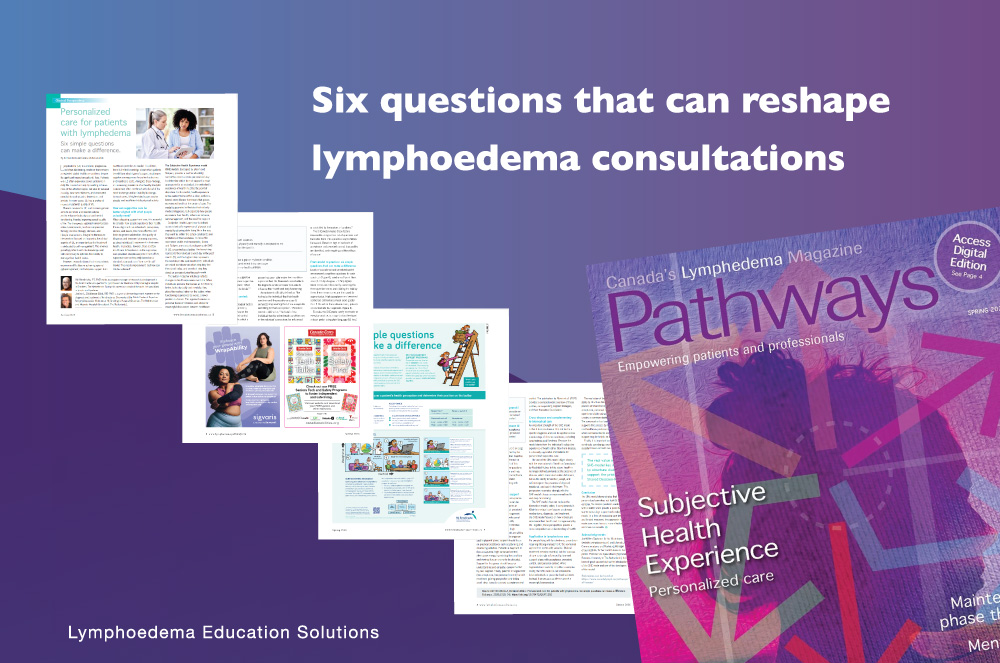
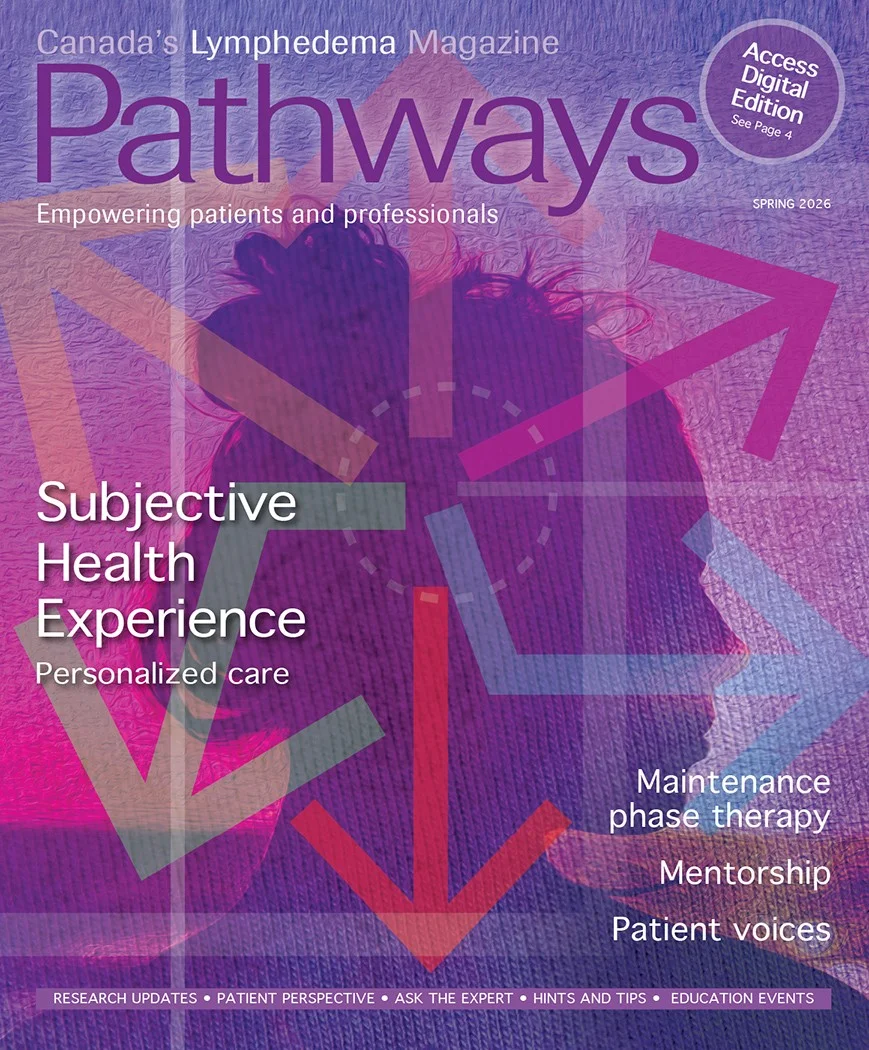
Originally published in Pathways (Volume 15 Issue 2 Spring 2026) Copyright 2026, Canadian Lymphedema Framework. Reprinted with permission.
Hendrickx, Ad and Dickinson-Blok, Janine. Pathways. 2026;15(2): 5-8. https://doi.org/10.70472/QCAF1202
A recent article in Pathways (Spring 2026) offers a simple but powerful reminder: even the best clinical plans fall short if they don’t align with how a patient is experiencing their condition.
In lymphoedema care, we often focus on what needs to be done—compression, exercise, skincare, and long-term management. But this paper highlights a key gap. Many patients struggle with self-management not because they lack information, but because the support they receive doesn’t match their readiness, capacity, or perspective.
A small shift in focus
The article introduces the Subjective Health Experience (SHE) model, which centres on two familiar but sometimes under-explored ideas:
- Acceptance – how a person is making sense of living with lymphoedema
- Perceived control – how much influence they feel they have over it
These are explored through six simple questions. For many clinicians, this may feel less like a new tool and more like a gentle structure around conversations that are already happening.
It can be as subtle as noticing how a patient responds to questions like:
- “How are you feeling about managing this at the moment?”
- “Do you feel you have some control over what’s happening day to day?”
Reflection for practice
- When a patient seems “stuck,” what might be sitting underneath. Capacity, confidence, or acceptance…
- Are there moments where adjusting how support is offered could be as important as what is offered?
- Could a brief check-in around control or acceptance open up a different kind of conversation?
Noticing patterns in responses
What the model offers is a way of making these insights more visible.
Some patients may appear to have accepted their condition but feel unsure how to act. Others may be highly motivated but frustrated or resistant. Some may still be coming to terms with the diagnosis altogether.
Recognising these differences can help explain why the same advice may land differently from one person to another.
Adapting support, where it feels appropriate
For those already tailoring their approach, this framework may simply offer language to describe what you are doing intuitively.
In some cases, it might prompt small adjustments, such as:
- leaning a little more into practical planning when someone feels overwhelmed
- allowing space for reflection or validation when there is frustration or resistance
- simplifying goals when both acceptance and confidence are low
These are often small shifts rather than major changes, but they can influence how supported a patient feels in managing their condition.
Supporting conversations, not replacing them
Importantly, the SHE model does not replace clinical reasoning or established care pathways. Instead, it complements them by bringing the patient’s lived experience more explicitly into the conversation.
For lymphoedema care, where long-term self-management is essential, this alignment can make a meaningful difference over time.
A helpful reminder
For many clinicians, the value in this article may simply be as a reminder:
that understanding where a patient is starting from can be just as important as deciding what comes next.
Even a brief check-in around acceptance and perceived control can sometimes open up a different kind of conversation, one that supports not just adherence, but confidence and engagement.
Read the full article
This article was published in the Spring 2026 edition of Pathways, released for World Lymphoedema Awareness Day.
You can access the full issue and read the complete article here: https://www.canadalymph.ca/pathways-online/2026-15-02-spring/


