
Supporting Compression Therapy in Practice
Practical tools, supplier insights, and shared knowledge to strengthen clinical outcomes
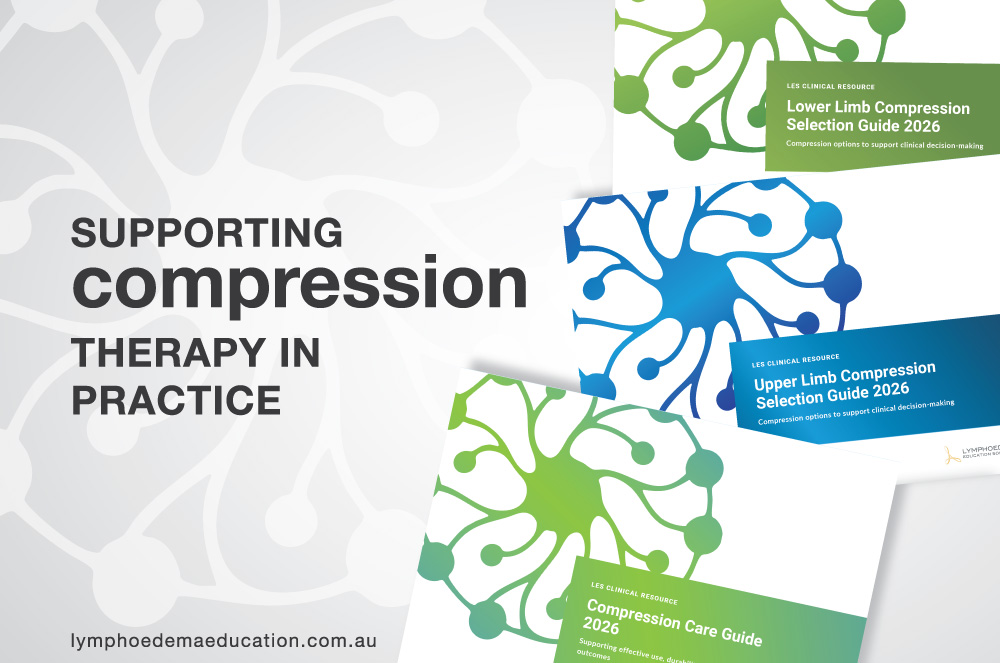
Compression therapy remains a cornerstone of lymphoedema and chronic oedema management. Yet in practice, its success is shaped not just by prescription, but by how well it is supported, understood, and sustained over time.
Clinicians are often navigating more than garment selection alone. Questions around product variation, ordering pathways, garment performance, and patient-specific challenges require not only clinical expertise—but also confident engagement with suppliers and manufacturers.
To support this, LES has developed a suite of practical resources designed to strengthen both clinical decision-making and clinician–supplier collaboration.
Beyond prescription: the role of supplier engagement
Compression therapy sits at the intersection of clinical care and product application. While clinicians bring assessment, reasoning, and patient-centred care, suppliers contribute:
- Detailed product knowledge and variation across ranges
- Guidance on garment selection and customisation
- Insight into ordering processes and lead times
- Support with troubleshooting fit or performance issues
- Education on care requirements specific to materials and design
When clinicians actively engage with suppliers, it supports:
- More precise garment selection
- Improved problem-solving when challenges arise
- Greater confidence in navigating product options
- Clearer, more accurate patient education
This is not about reliance—it is about informed collaboration that strengthens outcomes.
LES Compression Support Resources
These downloadable tools are designed to bridge clinical practice with real-world product use, drawing on both evidence-informed care and supplier-informed guidance.
1. Compression Care Guide
A comprehensive reference to support garment maintenance, durability, and performance.
This guide brings together manufacturer-informed instructions alongside practical clinical considerations.
It includes:
- Washing frequency aligned with garment use
- Safe washing and drying practices to preserve compression integrity
- Detergent recommendations to avoid fibre damage
- Handling techniques to reduce wear and tear
- Moisturising guidance to support skin health
Importantly, the guide highlights variations across manufacturers, reinforcing the importance of checking product-specific instructions and engaging with suppliers when needed.
In practice:
Use this guide to provide consistent patient education while remaining responsive to the specific garment, brand, and material in use.
2. Upper Limb Compression Guide
Targeted support for upper limb garment selection and management.
This resource supports clinicians to navigate:
- Product options across sleeves, gloves, and integrated systems
- Fit considerations influenced by shape, swelling distribution, and function
- The impact of garment design on daily activities and independence
- When to seek supplier input for customisation or adjustments
In practice:
Use this guide alongside supplier consultation to refine garment selection, particularly in complex or fluctuating presentations.
3. Lower Limb Compression Guide
Structured guidance for managing lower limb compression needs.
This resource addresses:
- Product selection across foot, ankle, and leg involvement
- The role of wraps, layering systems, and garment combinations
- Considerations for mobility, limb shape, and disease progression
- Practical challenges such as donning, tolerance, and garment replacement
In practice:
Use this guide to support clinical reasoning while drawing on supplier expertise for product-specific solutions and ordering pathways.
Strengthening consistency through shared knowledge
A key aim of these resources is to reduce variability—not only in patient education, but in how clinicians engage with the broader compression landscape.
- When clinicians combine:
- Clear, structured guidance
- Product-specific knowledge
- Open communication with suppliers
…patients benefit from more consistent, confident care.
This approach supports:
- Improved garment selection and fit
- Greater adherence and wear tolerance
- Reduced garment failure and unnecessary replacement
- Stronger patient understanding and self-management
Integrating these tools into your practice
These resources are designed to work alongside—not replace—clinical expertise and supplier relationships.
They can be used to:
- Support patient education at the point of prescription
- Guide follow-up conversations and troubleshooting
- Reinforce care and maintenance instructions
- Facilitate clearer communication with suppliers
- Support less experienced clinicians in navigating product options
A final reflection
Compression therapy is not a single decision, it is an ongoing process shaped by clinical insight, patient experience, and product performance.
By strengthening how we connect these elements, through practical tools, consistent messaging, and meaningful engagement with suppliers, we can support more effective, sustainable outcomes for the people we care for.
Acknowledging our Industry Partners
These resources have been developed with the valued support of the following industry partners, who have contributed product knowledge, care recommendations, and insights into compression use and performance in practice.
This collaboration supports more informed, consistent care. LES remains committed to independent, evidence-informed education, and clinicians are encouraged to apply their own clinical reasoning in all decision-making.