Top Insights This Year
From Lymphoedema Insights for Health Professionals
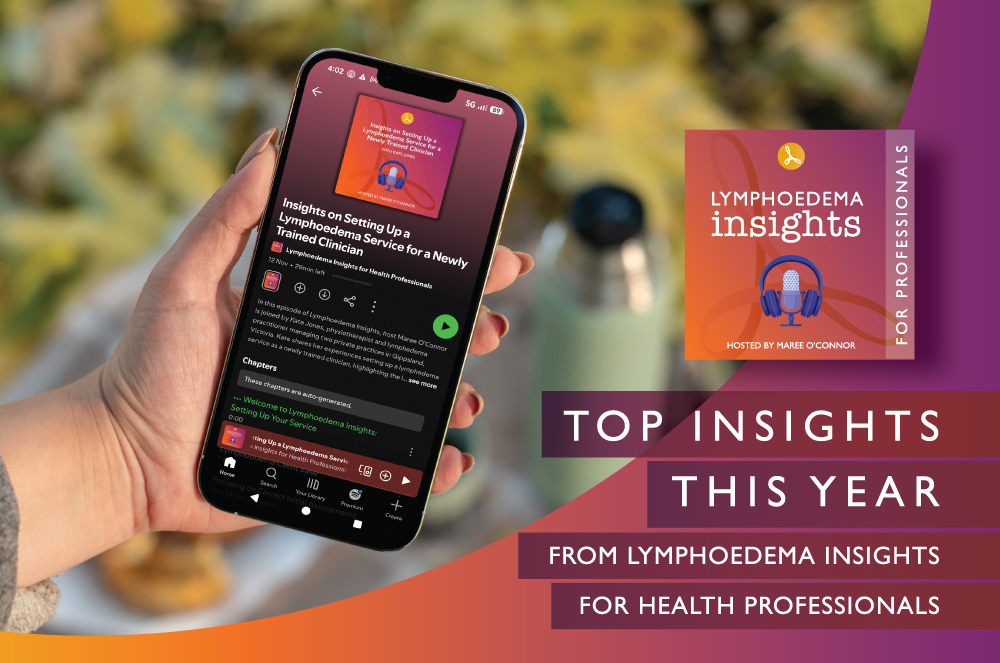
🎧 Catch up now
1. Assessment Is the Foundation of Everything
From Intermittent Pneumatic Compression (IPC) to wound care, exercise planning, and service development, every episode reinforced the same principle:
Good outcomes begin with good assessment.
Clinicians discussed the importance of:
- palpation, observation, and functional assessment
- pitting oedema testing
- tracking change over time rather than relying on single measurements
Whether using tape measures, BIS, compression systems, or coaching conversations, assessment was repeatedly positioned as the guide — not the add-on — to treatment decisions.
2. Technology Works Best When It Supports Clinical Reasoning
Across multiple episodes, technology was framed as a support to thinking, not a replacement for it.
Key insights included:
- IPC supports fluid movement and self-management when protocols are individualised and clinically supervised.
- Bioimpedance Spectroscopy (BIS) offers objective, trackable data that complements — rather than replaces — traditional measures.
- Trending data over time is far more useful than one-off readings.
When used thoughtfully, technology can:
- enhance confidence in decisions
- support early detection
- empower patients through visible progress
But only when grounded in sound clinical judgement.
3. There Is No “Recipe” — Individualisation Is Essential
Across IPC, compression selection, exercise, and chronic oedema management, the podcast consistently challenged one-size-fits-all thinking.
Key considerations highlighted included:
- comorbidities and contraindications
- mobility, cognition, and support at home
- skin integrity and tolerance
- cost, access, and practicality for the client
Effective care meant adapting:
- compression type
- treatment intensity
- pacing of exercise
- appointment length
to the person in front of you, not the protocol alone.
4. Managing Oedema Is Critical to Wound Healing
The episode on chronic oedema and wound care highlighted a gap that many clinicians encounter in practice:
wounds will recur if oedema is not adequately addressed.
Insights included:
- the importance of identifying oedema even when swelling is subtle
- integrating oedema assessment into wound pathways
- planning for discharge and long-term compression, not just acute healing
This episode also underscored the need for better education and collaboration between hospital and community services — and stronger training pathways for clinicians.
5. Confidence in Practice Comes from Support, Not Isolation
From newly trained clinicians to experienced practitioners, collaboration emerged as a marker of safe practice, not uncertainty.
Key themes included:
- the value of mentoring and peer discussion
- working closely with garment suppliers and equipment providers
- knowing when to seek advice in complex cases
For clinicians building services — particularly in regional areas — confidence grew from:
- strong assessment frameworks
- trusted professional networks
- ongoing learning rather than “having all the answers”
6. Recovery Is Not Just Physical — Safety and Meaning Matter
The episode on exercise and health coaching after breast cancer expanded the definition of recovery.
- Important insights included:
- fatigue, stress, fear, and loss of confidence are common barriers to exercise
- motivation improves when the nervous system feels safe
- curiosity-based conversations support sustainable behaviour change
Drawing on neuroscience and coaching principles, this episode highlighted that:
- small, meaningful steps build momentum
- enjoyment and values drive long-term adherence
- recovery is not about “returning to normal,” but creating a new balance
This perspective complemented clinical rehabilitation approaches and reinforced the importance of holistic care.
7. Person-Centred Care Requires Time, Flexibility, and Listening
Across all episodes, person-centred care was described not as a buzzword, but as daily practice.
This included:
- listening to patient priorities
- adapting compression and exercise options to real-world capacity
- educating patients so they understand why they’re doing something
- supporting self-efficacy and shared decision-making
Time spent explaining, reflecting, and adjusting was consistently linked to better long-term outcomes.
A unifying insight from the year so far
Taken together, the conversations emphasise the following…
Effective lymphoedema and chronic oedema care is thoughtful, layered, and collaborative.
It involves:
- strong assessment
- appropriate use of evidence and tools
- respect for individual context
- and support for both physical and psychological wellbeing
Whether working in acute care, private practice, community health, or regional settings, these insights point toward care that is sustainable for clinicians and empowering for clients.
Catch Up on the Episodes
🎧 Episodes 1–6 of Lymphoedema Insights for Health Professionals are available on Spotify and Apple Podcasts
If you’re new to the podcast, these episodes offer a strong foundation for confident, evidence-informed, person-centred practice.